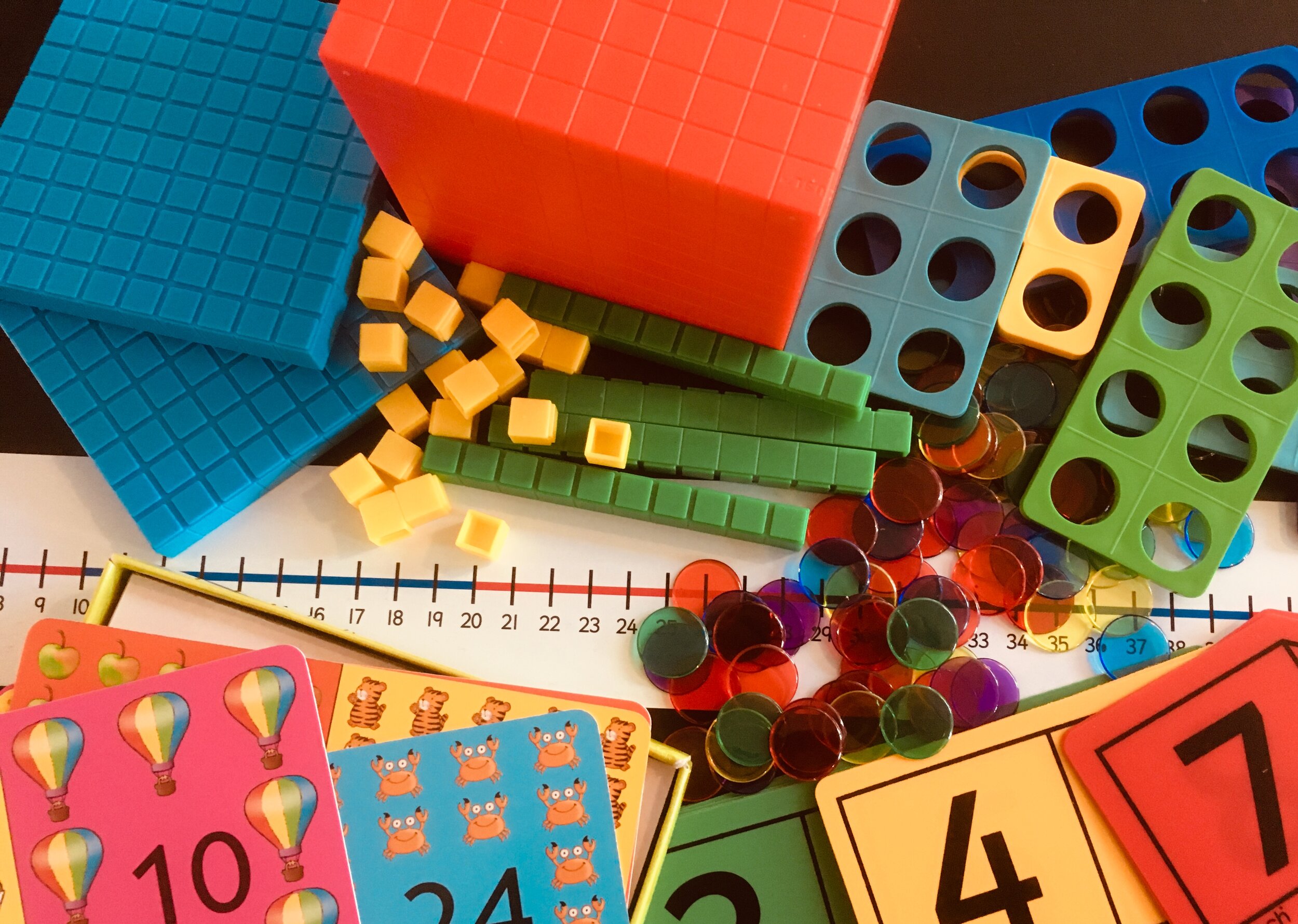

Level 1 - Subject Content
Level 1 builds on the concept of number and number sense, introducing and using numbers up to 20. Expands the understanding of subtraction to ‘more than’ and ‘the difference’. Focuses on the identification of language and recognition of units associated with money, o’clock time, measurement, shape and position. Introduces data handling in the form of simple charts and diagrams.
The Educator Guides contain the curriculum structure - levels, topics and objectives - delivered in an accessible way for all educators to understand and implement. They are the essential ingredient to successfully deliver the programme. They are only available in hardcopy and you can purchase them here.
TOPIC 1 - USING NUMBERS AND THE NUMBER SYSTEM - WHOLE NUMBERS
1. Read, write, order and compare numbers up to 20
2. Use whole numbers to count up to 20 items including zero
3. Add numbers which total up to 20, and subtract numbers from numbers up to 20
4. Recognise and interpret the symbols +, - and = appropriately
TOPIC 2 - USING COMMON MEASURES, SHAPE AND SPACE
5. Recognise coins and notes and write them in numbers with the correct symbols (£ & p), where these involve numbers up to 20
6. Read 12 hour digital and analogue clocks in hours
7. Know the number of days in a week, months, and seasons in a year; Be able to name and sequence
8. Describe and make comparisons in words between measures of items including size, length, width, height, weight and capacity
9. Identify and recognise common 2-D and 3-D shapes including circle, cube, rectangle (incl. square) and triangle
10. Use everyday positional vocabulary to describe position and direction including left, right, in front, behind, under and above
TOPIC 3 - HANDLING INFORMATION AND DATA
11. Read numerical information from lists
12. Sort and classify objects using a single criterion
13. Read and draw simple charts and diagrams including a tally chart, block diagram / graph
All Record of Progress, Content and Baseline Assessments use the same nomenclature reference that directly relates to the subject content. For example:
Topic 1 - 2. Use whole numbers to count up to 20 items including zero will be 1L1.2 - Level 1, Topic 1, Subject 2
Topic 3 - 12. Sort and classify objects using a single criterion will be 1L3.12 - Level 1, Topic 3, Subject 12
Note: In first edition of Book 1 the nomenclature for Level 1 topics is slightly different and represented as ‘1E’ instead of ‘1L’ .
LEVEL 1 STUDENTS ARE EXPECTED TO BE ABLE TO:
use the knowledge and skills listed above to recognise a simple mathematical problem and obtain a solution [a simple mathematical problem is one which requires working through one step or process];
address individual problems each of which draw upon knowledge and/or skills from one mathematical content area [i.e. number and the number system; common measures, shape and space; information and data];
use given mathematical information and recognise and use simple mathematical terms appropriate to Level 1;
use the methods given above to produce, check and present results that make sense; and
provide a simple explanation for those results.
The context for simple problems at Level 1 should be familiar to all students and easily described.